Each matter starts from a standard template, metadata, and permissions instead of ad-hoc data entry.
Strategic journey
01
02
03
04
From scattered legal office to a scalable operating engine
Consolidate data
Documents, matters, clients, billing, and deadlines are consolidated into one matter record to end searching across email and shared folders.
Enforce workflows
Approvals, version control, and permissions are enforced through workflow instead of relying on individual habits or handshakes.
Add governed AI
AI assists only on authorized sources and every answer includes source traces for verification.
Scale with confidence
Once data, process, and controls are clear, Lexora turns operational capability into scalable competitive advantage.
Customer Reality
The problem is not software. It is operational order.
01
The Reality
Most legal teams manage matters across a combination of email threads, shared folders, Excel trackers, and disconnected billing systems. For each active matter, the team leader must manually chase status updates, locate the latest document version, verify billing hours, and confirm approval sign-offs — all before a single piece of client work moves forward. Deadlines are tracked in personal calendars. Matter knowledge is locked in the minds of individual lawyers. When a senior lawyer leaves, the matter history leaves with them.
02
Why It Matters
Legal operations risk is not limited to losing a case. Missed deadlines, lost document versions, unrecoverable billing evidence, and uncontrolled matter access are operational risks that translate directly to professional liability, client loss, and regulatory exposure. For law firms and corporate legal departments, the inability to reconstruct a matter's full history on demand is not a documentation problem — it is a governance failure.
03
LLA's Insight
Most legal software is built around document storage or billing. Lexora is built around the matter as the central operating unit. Every document, every task, every billing entry, every AI research result, and every approval is connected to the matter that generated it. This means legal teams can reconstruct the full history of any matter — from client intake to final invoice — without searching email, shared drives, or individual inboxes.
Best Fit
Who this is built for
Law firms, legal consultancies, corporate legal departments, compliance teams, and advisory firms managing sensitive matters, client pipelines, billable hours, and document governance.
Architecture
Modular ASP.NET Core services, PostgreSQL-backed operational records, role-based access, API-first integrations, and audit-ready workflows.
Problems Solved
Pain points LLA designs around
Client pipeline has no AI-assisted visibility
Timesheet and billing evidence is incomplete
Legal research takes too many hours
Audit trail is not cryptographically verified
Capability Pillars
From real problems to measurable outcomes
Each capability is designed around a specific operational problem - not a generic feature checklist.
Matter-Centric Operational Control
Problem
Matter data is fragmented across email, shared folders, and personal trackers. There is no single authoritative view of any active matter.
Outcome
Every matter has a single, controlled record connecting client, lawyer, documents, tasks, deadlines, billing, and AI research.
G
All matter actions are attributed to named users with timestamps. Matter access is role-controlled and logged.
Legal Document Governance
Problem
Document versions multiply in shared drives. There is no enforced version control and no audit record of who accessed or edited what.
Outcome
Documents are connected to the matter that generated them, version-controlled, and access-gated by role and matter assignment.
G
Document access and edit history is fully auditable. Every version is retained and retrievable.
Deadline and Task Management
Problem
Deadlines are tracked in personal calendars and sticky notes. The firm has no system-level view of all upcoming legal deadlines across matters.
Outcome
All matter deadlines, task assignments, and milestones are managed in the platform with escalation alerts for overdue items.
G
Deadline management records are available for professional liability review — showing who was responsible and when alerts were issued.
Billing Evidence and Timesheet Control
Problem
Billing records are reconstructed from memory, notes, and email threads. Invoices are challenged because the evidence is incomplete.
Outcome
Timesheet entries are linked to the matter, lawyer, and task. Billing evidence is complete, chronological, and client-presentable.
G
Billing records form part of the matter audit trail — every entry attributed, timestamped, and non-editable after approval.
AI Legal Research with Source Traceability
Problem
Legal research takes too long and relies on individual lawyers knowing where to look. Research findings are not reused across matters.
Outcome
AI assistant searches the legal corpus — Vietnamese regulations, internal precedents, and matter knowledge — and returns answers with source citations.
G
Every AI answer records the query, the source documents used, and the lawyer who ran the research. Research is reusable across matters.
Modules
Functional modules
Client CRM with pipeline (VIP/Active/Lead/At Risk/Dormant)
Matter management with deadline control
Timesheet, billing, and utilization tracking
Legal document control and workflows
AI / RAG legal research platform
BI reporting and audit trail
Workflow control
Configurable operating workflows with status tracking and approval visibility.
Role-based access
Permissions designed for admins, managers, operators, reviewers, and external users.
API integration
Connects to ERP, CRM, payment, invoice, shipping, warehouse, document, and AI systems.
Audit-ready data
Tracks important actions, status changes, and operational records for review and reporting.
Platform Capability
What teams actually see and use
These showcase panels are built from operating screens, workflows, demo data, and control evidence.
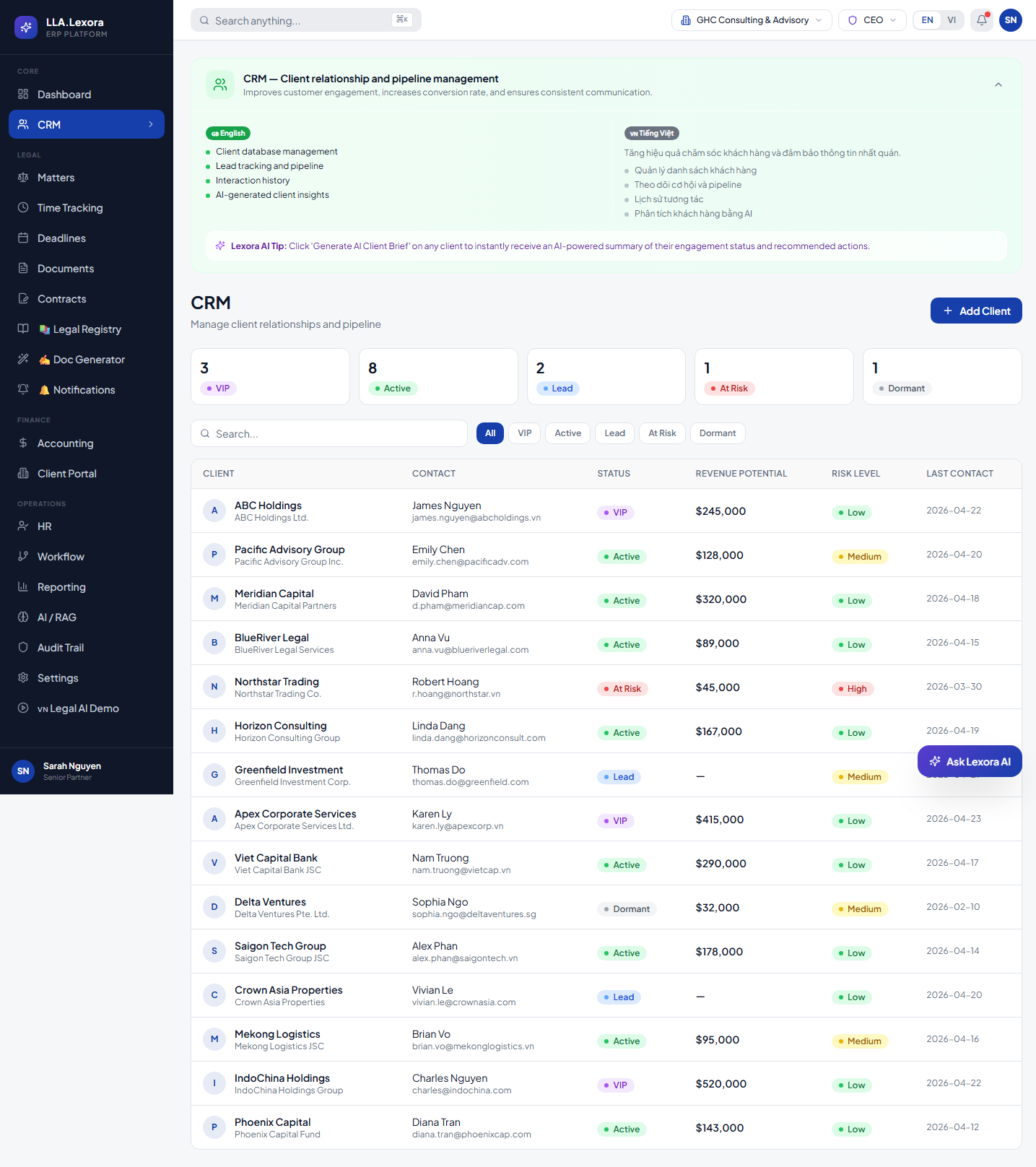
Client Pipeline with AI Insights
Track clients as VIP, Active, Lead, At Risk, or Dormant. AI generates engagement summaries, recommends follow-up actions, and flags clients at retention risk automatically.
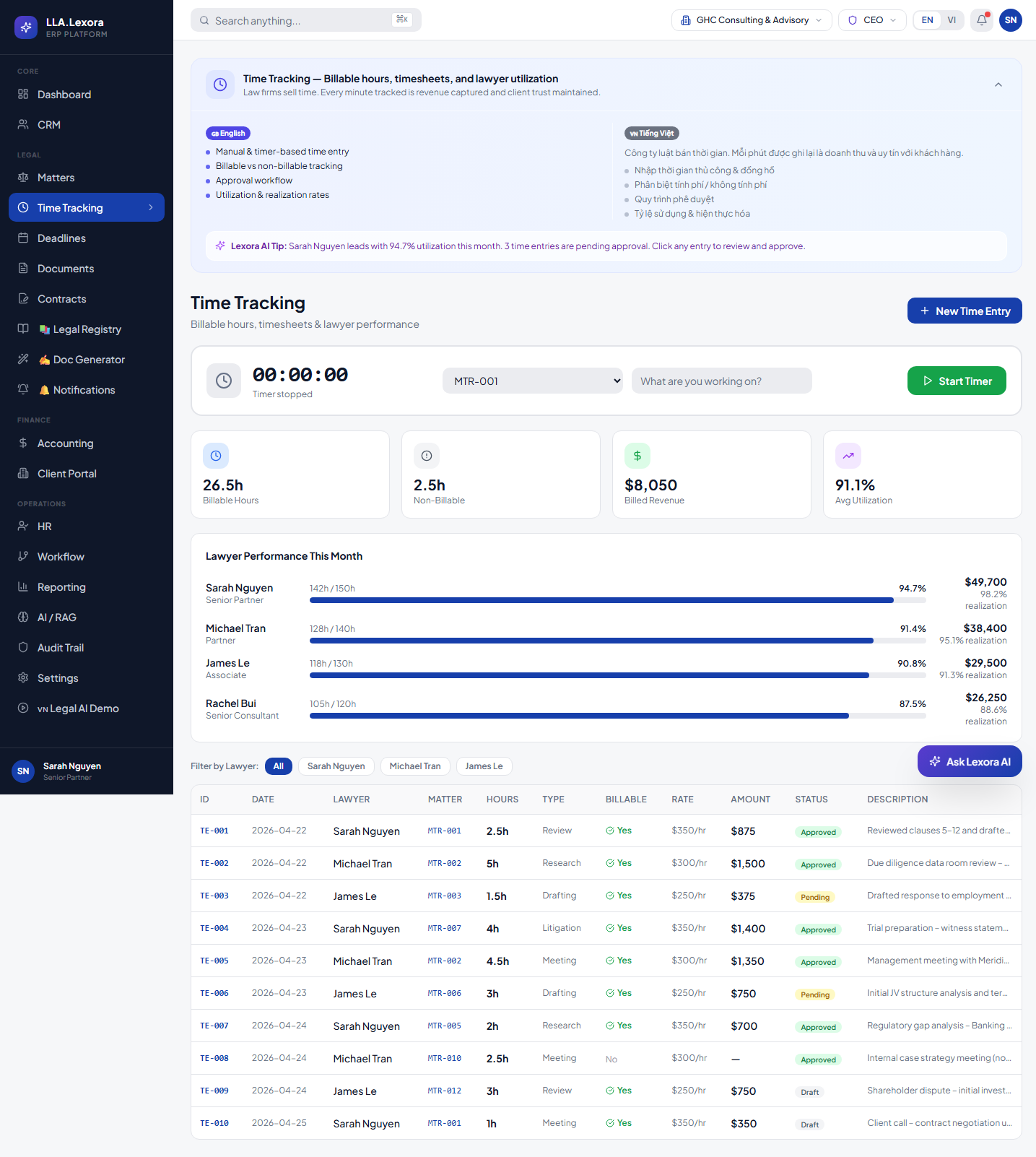
Lawyer Time Tracking + Utilization
Live timer per matter with billable/non-billable classification. Lawyer performance dashboard shows utilization, billed revenue per person, realization rate, and monthly targets.
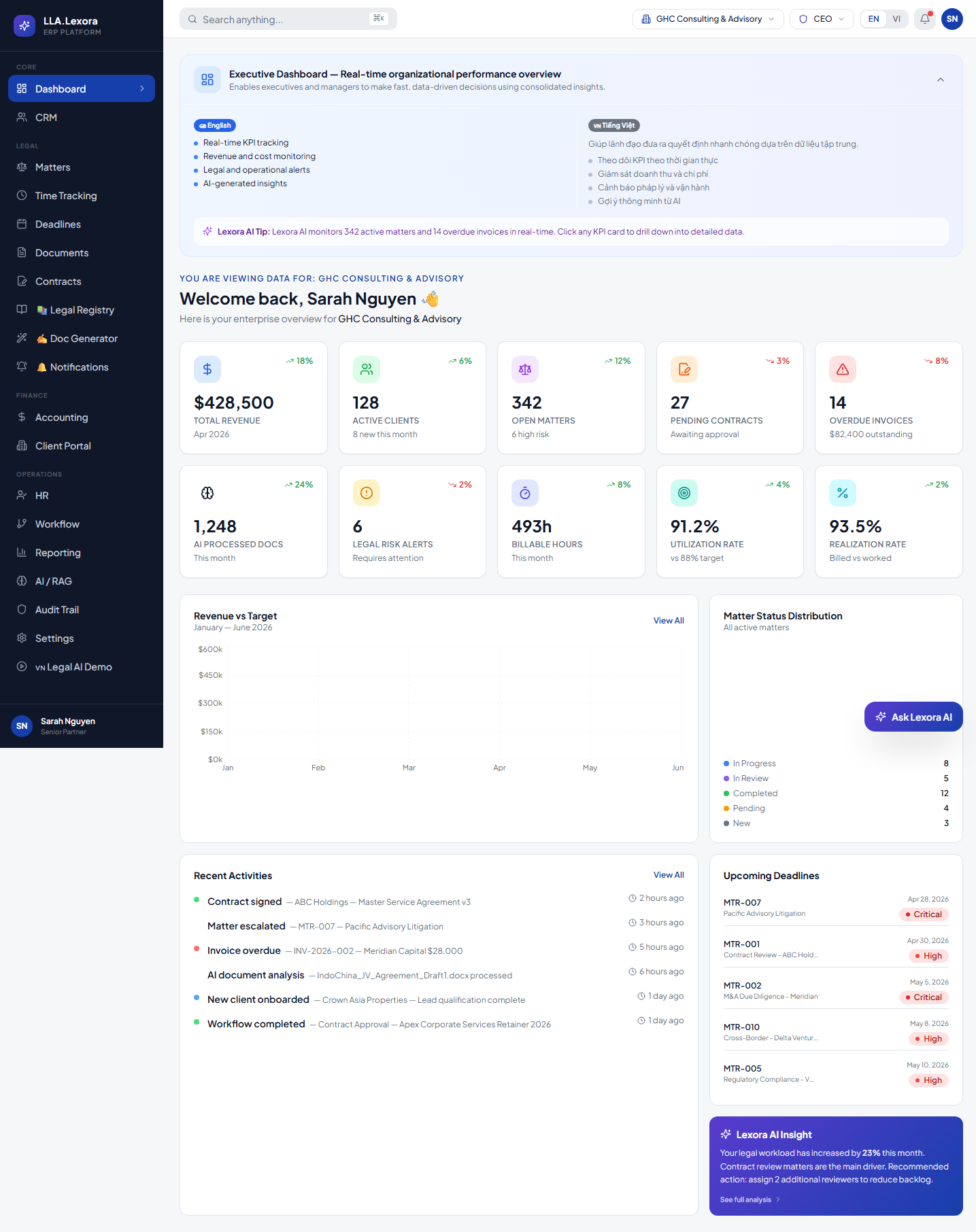
BI & Reporting Dashboard
Revenue trend, department workload, matter status distribution, top clients by revenue, client satisfaction score, and AI-processed document count — all exportable.
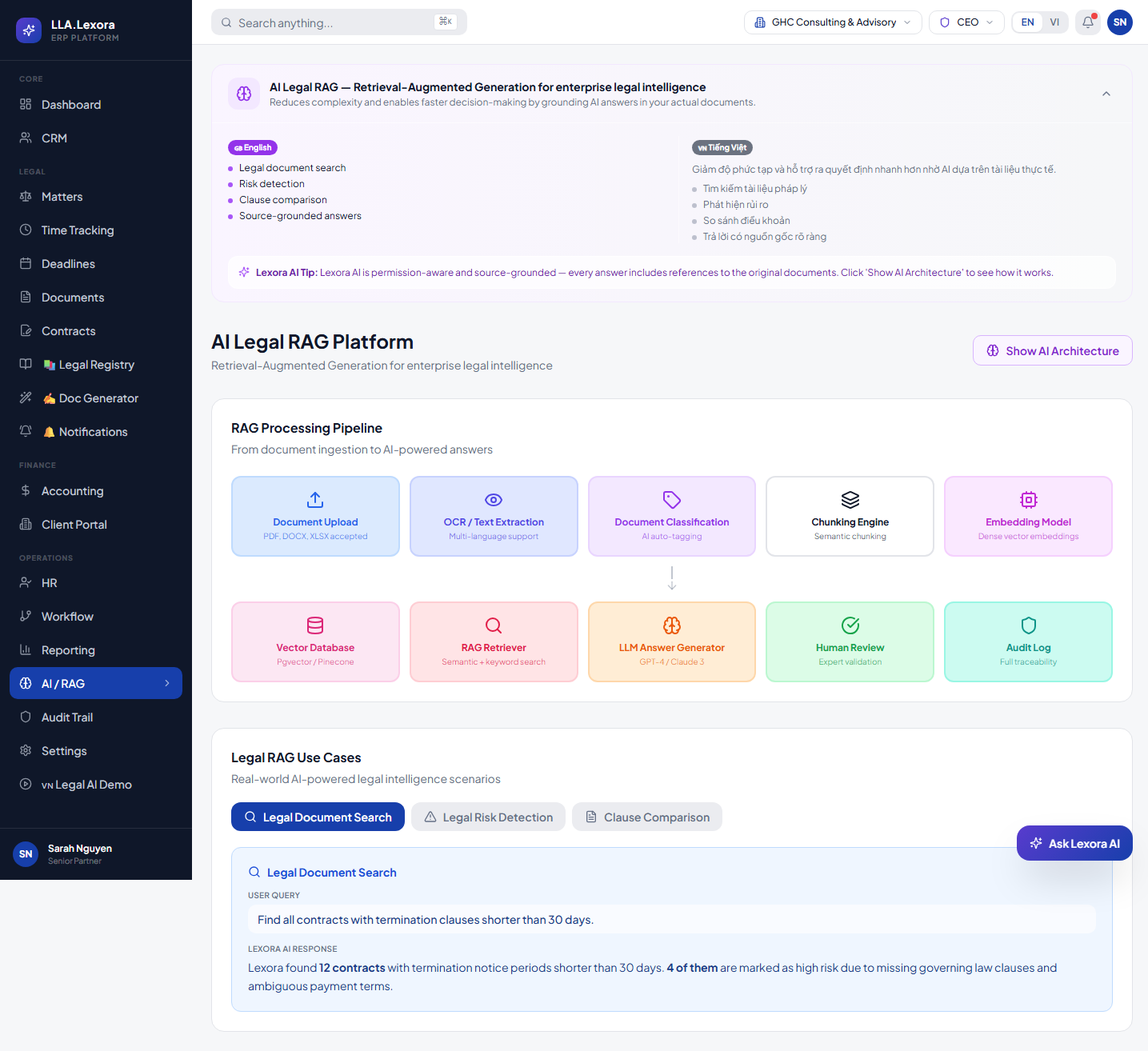
AI / RAG Legal Research
10-step RAG pipeline: document upload → OCR → classification → chunking → embeddings → vector database → retrieval → LLM answer → human review → audit log. Source-cited answers.
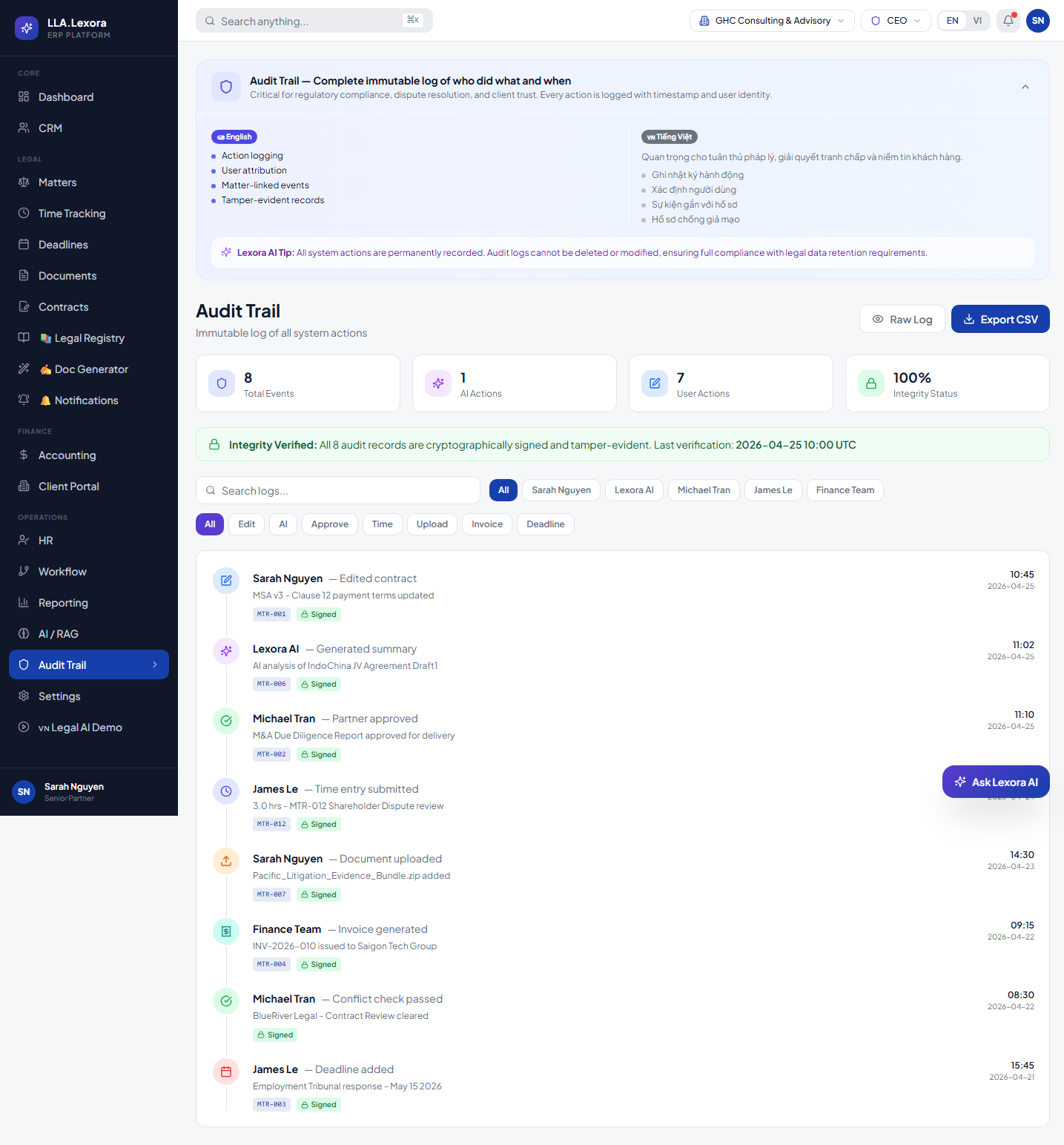
Cryptographic Audit Trail
Every action — edit, AI summary, approval, time entry, document upload — is SHA-signed and tamper-evident. 100% integrity status. Raw log and CSV export available.
Matter + Deadline Control
Full matter lifecycle with client, assigned lawyer, status, priority, deadline, fee arrangement, and AI-assisted triage. Deadline alerts prevent missed court filings or contract dates.
Business Intelligence — Q2 2026 Sample
$1,323,500
Total Revenue YTD
+18% vs last period
42
Total Matters Closed
+12% vs last period
94.2%
Client Satisfaction
+2.1% vs last period
3,847
AI Documents Processed
+24% vs last period
Top Clients by Revenue: IndoChina Holdings $520k · Apex Corporate Services $415k · Meridian Capital $320k · Viet Capital Bank $290k
Transformation Journey
From current state to controlled operations
LLA does not begin with software configuration. LLA begins with operating model design.
01
01
Matter and Document Audit
LLA maps your current matter management approach, document storage locations, billing systems, and approval processes. Every gap in traceability is identified.
OK Matter governance gap report
02
02
Operating Model for Legal
LLA designs the matter structure, document taxonomy, role model, billing workflow, and AI research integration approach for your practice area.
OK Legal operating model blueprint
03
03
Platform Configuration
Matter types, document templates, approval chains, billing rules, and AI knowledge base connections are configured to your practice requirements.
OK Working Lexora instance with practice-specific configuration
04
04
Data Migration and Integration
Existing matter records, client data, and document archives are migrated. Integration with accounting and document storage systems is established.
OK Historical matter data migrated and accessible
05
05
AI Knowledge Base Activation
Legal corpus — Vietnamese regulations, internal precedents, and matter knowledge — is ingested, vectorised, and connected to the matter research workflow.
OK AI legal research operational with traceable sources
Demo Product Screenshots
Screens from real LLA demo environments
These screenshots are used as product evidence: real modules, realistic data, visible workflow states, and operational screens that make the website feel specific to LLA rather than template-generated.
CRM client pipeline
Client list with VIP / Active / Lead / At Risk / Dormant pipeline stages, AI-generated client insights, revenue potential, risk level, and last contact date.
Timesheet and lawyer performance
Live timer per matter, billable/non-billable classification, lawyer utilization bars (94.7%), billed revenue, realization rate, and monthly target tracking.
Business intelligence reports
Revenue trend chart, department workload bars, matter status donut, top clients by revenue, client satisfaction, and AI document processing volume — all exportable.
AI / RAG legal platform
10-step RAG pipeline: document upload → OCR → classification → chunking → embedding → vector DB → RAG retrieval → LLM answer → human review → audit log.
Cryptographic audit trail
Immutable, SHA-signed audit log for every action: edit, AI summary, approval, time entry, document upload. 100% integrity verified. Raw log and CSV export.
Story Flow
Sticky product storytelling driven by CMS data
Modules that map to real operating work
Client CRM with pipeline (VIP/Active/Lead/At Risk/Dormant)
Matter management with deadline control
Timesheet, billing, and utilization tracking
Legal document control and workflows
AI / RAG legal research platform
BI reporting and audit trail
Example operating flow
01
Capture
Collect structured data, documents, roles, and required validation at the point work begins.
02
Route
Move requests through role-based workflows, approvals, assignments, and exception handling.
03
Integrate
Synchronize external services, files, payment, invoice, shipping, AI, or storage events through APIs.
04
Report
Provide dashboards, audit trails, exports, and management views that reflect the real operating state.
Use cases
Law firm operations control
Corporate legal department pipeline
AI-assisted legal knowledge base for Vietnamese law
Integration story
SharePoint / Synology / NAS
E-contract and SmartCA signing
Accounting and billing systems
AI/RAG infrastructure (Qdrant, LiteLLM, OpenAI)
Security and deployment posture
Security
Role-based permissions, audit logs, validation, secure file handling, approval workflows, and environment-based configuration.
Deployment
Private cloud, VPS, Docker/Coolify, IIS, or hybrid deployment depending on the customer's security and infrastructure requirements.
Integration Ecosystem
Not standalone. Connected.
This platform is designed to connect with the broader LLA ecosystem and third-party systems.
LLA Platform
LLA AI Knowledge Hub
Legal corpus ingestion, vector search, and RAG pipeline for matter research and document intelligence.
LLA Platform
LLA Document & E-Contract Suite
Contract lifecycle management connected to matter records — from drafting to approval to signing.
LLA Platform
LLA ERP Core
Client record synchronisation and billing integration for firms using LLA's operational platform.
External Storage
SharePoint / Synology / NAS
Document archive connection for firms with existing document storage infrastructure.
External Integration
Accounting Systems
Billing export and invoice generation connected to approved timesheet records.
Implementation Roadmap
From signature to live operations - a clear path
Each phase includes clear delivery gates, ownership, and control checkpoints so operations teams can track progress week by week.
Phase 1 — Foundation (Weeks 1–3)
Matter structure, client records, user roles, and document taxonomy configured.
Delivery milestonePhase 2 — Document and Task Layer (Weeks 4–6)
Document management, version control, task system, and deadline tracking operational.
Delivery milestonePhase 3 — Billing and Integration (Weeks 7–9)
Timesheet, billing workflow, and accounting integration configured and tested.
Delivery milestonePhase 4 — AI Research and Launch (Weeks 10–12)
Legal corpus ingested, AI research connected to matters. Team trained. Go-live.
Delivery milestone
Business Outcomes
Specific outcomes by leadership role
Each function gets specific, measurable outcomes - not vague benefits.
CEO / Managing Director
Giám đốc Điều hành
- Matter portfolio visibility across all active engagements without chasing individual lawyers for status.
- Partner confidence that billing evidence is complete and client-defensible.
COO / Head of Operations
Giám đốc Vận hành
- Deadline management is system-enforced — not reliant on individual calendars and memory.
- Matter handover between lawyers takes hours, not days, because the full record is in the platform.
Compliance / Legal
Tuân thủ & Pháp lý
- Every matter action is attributed, timestamped, and audit-retrievable — professional liability ready.
- Document access is controlled and logged. No unauthorised access without a trace.
CTO / Head of IT
Giám đốc Công nghệ
- Private deployment option. Matter data stays on firm-controlled infrastructure.
- API-ready for integration with document storage, accounting, and external AI services.
Product Detail
Hệ thống quản trị doanh nghiệp dành riêng cho văn phòng luật, quản lý vụ việc, tài liệu, quy trình và billing.
Governance Profile
Access control, audit, and compliance
Lexora implements matter-level RBAC — lawyers see only the matters they are assigned to unless they hold elevated access roles. Document access is controlled at the folder, document, and version level. All access, edit, and download events are logged. Billing records are locked after approval. AI research queries and results are stored in the audit trail with source attribution. The platform supports private deployment on customer-controlled infrastructure with no mandatory cloud dependency.
Why LLA
What makes LLA's delivery different
01
Lexora is built around the matter as the central operating unit — not just a document store or a billing system.
02
LLA configures matter types, document taxonomy, billing rules, and AI research connections to your practice area requirements.
03
LLA supports private deployment for law firms where client data sovereignty is a non-negotiable requirement.
04
LLA's AI legal research is built on traceable sources — not a black box that cannot be cited in a legal context.
05
LLA has deep understanding of Vietnamese legal and regulatory frameworks relevant to the AI corpus design.
FAQ
Questions customers usually ask
Can this be customized?
Yes. LLA uses the product foundation as a starting point, then adapts workflows, data fields, roles, integrations, and reports to the customer's operating model.
Can it be deployed privately?
Yes. LLA supports private deployment using Docker/Coolify, IIS, PostgreSQL, object storage, and customer-controlled infrastructure when needed.
Does it support bilingual content?
The architecture supports English and Vietnamese content, including translated entity slugs for public detail pages.
Design the system around your operation
LLA can adapt this platform to your workflows, integrations, compliance model, and deployment environment.
Book a Consultation →